The Odyssey was always going to be ambitious. It’s the kind of art that can’t be made any other way. My only hope with Christopher Nolan’s version was that it would be entertaining and epic. That’s a tough task, but Nolan seemed like the right filmmaker to pull it off.
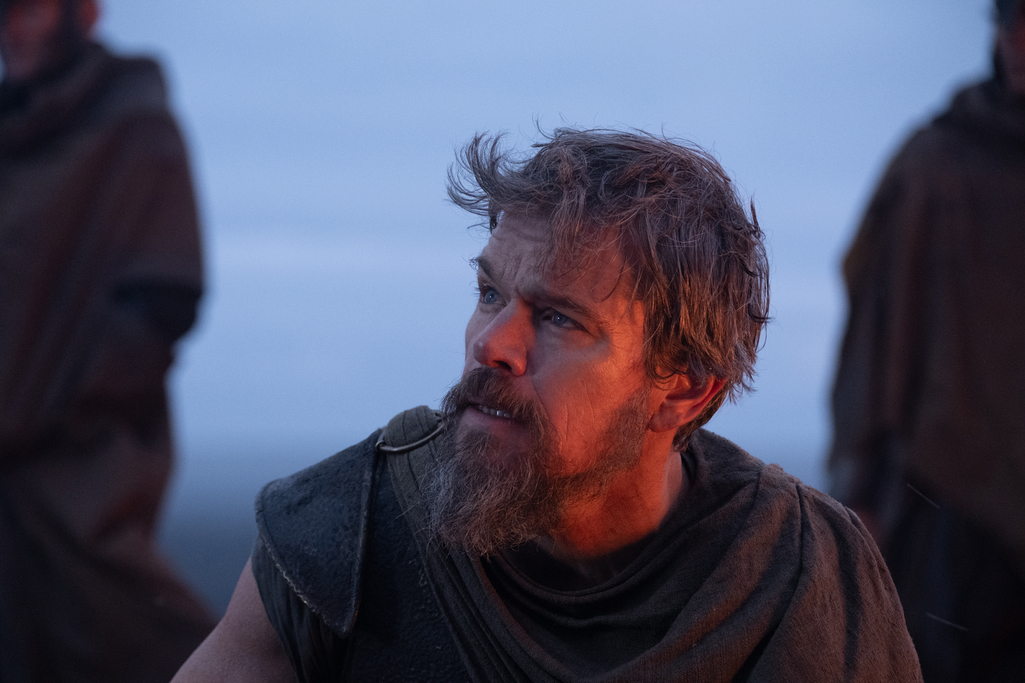
He also has help from a star-studded cast led by Matt Damon. As Odysseus, Damon journeys through one impossible trial after another in an effort to return home after the legendary Trojan War. Meanwhile, his family waits, clinging to the hope that he might somehow return after more than two decades away.
From the start, The Odyssey feels unmistakably like a Nolan film. While that’s usually a good thing, it hasn’t always been the case. Because of that, I held off on celebrating too early.
As the film unfolds, things continue to get better and better. That’s partly due to the coherent filmmaking despite the picture’s nonchronological structure. Nolan has experimented with nonlinear storytelling before. It worked brilliantly in Memento, proved divisive in Tenet, and left some audiences confused with Dunkirk.
Here, however, the structure never goes completely off the rails. It’s easy enough to follow and never feels like a gimmick. More importantly, there’s a purpose behind the fractured timeline, and by the end it justifies itself.
I’d also be remiss not to address the casting controversies that surrounded the film before its release. There were plenty of complaints from various corners of the internet, but they ultimately amount to very little. Many of the issues people focused on simply aren’t noticeable while watching the movie.
As I mentioned earlier, the cast is loaded with recognizable names. Ironically, the depth of the ensemble isn’t entirely necessary because many of these actors have surprisingly little screen time. Several performances feel more like extended cameos than fully developed supporting roles.
That isn’t to say they’re ineffective. Most of the cast makes the most of their limited appearances. Lupita Nyong’o, for example, brings a quiet elegance to Helen of Troy, even if the role itself is fairly small. The same can be said for Jon Bernthal and several others, who leave an impression despite not being on screen for very long.
Of course, the film belongs to Matt Damon. His performance anchors the entire story, balancing Odysseus’ determination, exhaustion, and vulnerability in a way that keeps the emotional stakes grounded even when the mythology grows larger than life. Rather than trying to overshadow the spectacle, Damon allows the character’s longing for home to remain the film’s emotional center.
Visually, The Odyssey is exactly what audiences expect from a Nolan production. The practical effects, sweeping locations, and large-format cinematography give the film a scale that modern blockbusters often struggle to achieve. Even during its quieter moments, there’s a sense that you’re watching something crafted with remarkable care.
If there’s one disappointment, it’s that the film never quite reaches the overwhelming sense of awe its premise promises. The individual moments are impressive, but the overall experience stops just short of feeling truly monumental. It’s an excellent adventure rather than an all-time cinematic spectacle.
Still, that’s a relatively minor criticism. The Odyssey succeeds because it treats its source material with sincerity instead of relying solely on spectacle. It’s a thoughtful adaptation that embraces mythology without sacrificing character, and it demonstrates that audiences are still willing to embrace ambitious storytelling when it’s handled by a filmmaker with a clear vision.
In the end, I thoroughly enjoyed The Odyssey. It may not deliver the overwhelming epic I had imagined, but it stands as another reminder of what ambitious filmmaking can still look like in Hollywood. Hopefully, studios continue investing in original, large-scale stories like this instead of relying exclusively on familiar franchises. If they do, moviegoers will have plenty more surprises—and memorable nights at the theater—to look forward to.